
Trust in Atonement: God, Creation, and Reconciliation


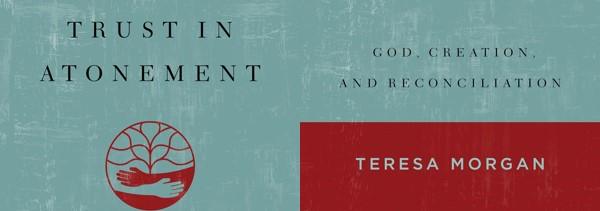
A few weeks before he died at the age of 93, a member of my Jesuit community said: ‘What matters is “trust” – trust in God’.[i] ‘Trust’ came over to me as an almost forgotten word which had a wide resonance, a healing and an enlivening promise. So to find ‘trust’ in the title of Teresa Morgan’s new book was very inviting. The ‘large’ words in her title – atonement, creation and reconciliation – gave trust a wide and hopeful environment. Born in England, Teresa Morgan is many things: Anglican priest, violinist, poet, theologian and academic with many publications[ii] who currently holds a chair at Yale Divinity School. And she works with words.
The shape of words
The words we use shape and are shaped by our varied cultures, religious and secular, and they do their work in many ways. There is indeed ‘faith’ in God. But in the Koine Greek of the New Testament, pistis can be rendered as ‘faith’ or ‘trust’ – words which have different colourations. Care about language shapes Teresa Morgan’s book. So in her text, ‘atonement’ is commonly written as ‘at-one-ment’, which does not sound like ‘making up for a wrong done’, but a ‘bringing together again’. Indeed Morgan rejoices at ‘seeing God as always happy to be reconciled to humanity rather than…[humanity] as needing to be reconciled’ (p.157). Here indeed is a pleasing and well-found place and context for trust.
Morgan is clear that a Christian understanding of Christ’s death emerges from his life and resurrection (p.129), and has a place in his ‘exaltation’ and ‘future coming’. Jesus trusts in the face of death and his trust is more than confirmed by resurrection. Cross and resurrection go together. Even so, Morgan does not focus here on the place or position of Jesus’s resurrection. Certainly resurrection matters. It is an ‘extra grace’ (p.131), or an ‘added grace’ (p.224), which helps to make the restoration of ‘trust’ possible, though – oddly – it is ‘not a necessary sequel to the crucifixion’ (p.118). Yet resurrection makes possible a real, new and very different presence among humankind of the Jesus who died: ‘as you did it to the least of these who are members of my family, you did it to me’; ‘I am with you always, to the end of the age’ (Matthew 25:40; 28:20). Resurrection is about Jesus and his presence in our unrisen world. This, Morgan does notice: ‘Jesus Christ is present where people seek to create or recreate trust’ (p.217). But the presence of the crucified Jesus among us is inextricably and inherently bound up with Jesus’s resurrection. Resurrection seems rather more than an ‘extra’ or ‘added’ grace – and Morgan is in a good position to deal with this ‘more than’.
A sense of presence
This ‘presence’ of the risen Jesus fits Ignatius of Loyola’s imaginative and conversational prayer in his Spiritual Exercises. And it goes along with his sense of the presence of ‘God’ in all things: ‘To see how God dwells in creatures: in the elements giving being; in the animals giving sensation; and in humankind granting the gift of understanding; and so also how he dwells in me, giving me being, life and sensation and causing me to understand’.[iii] This overall presence of ‘God’ is tied to Jesus’s resurrection – to which the Exercises have already been notably attentive.
A Jesuit friend, Rory Geoghegan, is a sculptor who made many versions of what he carefully called ‘A Cross of Resurrection’.[iv] My favourite is a fowler’s net shaped like a cross, with an abstract, angled figure almost flying out of the net like a bird beginning to fly free. Rory often refers to Psalm 91:3 – ‘the snare of the fowler’ – and there are other remarkably apposite lines in Psalm 124:7: ‘Our life, like a bird, has escaped / from the snare of the fowler’ (The Grail Psalms, Hebrew numbering). It is as if in ordinary and extraordinary experiences, we can (dimly) sense how life and death, cross and resurrection hold together. Sculpture, like poetry and theology, can begin to express a wonderful and mysterious unity – an ‘at-one-ment’.
Models of at-one-ment
Morgan mentions the various traditional models of atonement: ransom, satisfaction, penal substitution, moral influence and indeed liberation theology – a solidarity with those on the edge of life. Each of these has its own merits and difficulties. There is really no single and generally accepted model. In this situation, Morgan proposes her new picture based on trust. Clearly trust matters in human life, yet is often lacking in many or all of life’s shapes and dimensions – individual, inter-personal, historical, social, economic, political, national and international. The ‘trust model’ tries to work through these problems. And this is a long, arduous and problem-filled process. Simply put, God in Christ both trusts humankind and entrusts them (followers, disciples, apostles, Church…) with the gospel’s good news. Jesus trusts the Father, is entrusted by the Father, and entrusts his disciples. So humankind, who are trusted and entrusted by God, can come to trust God and one another. But these interwoven relationships are notably time dependent – they include our histories and our life stories.
Finding or regaining trust takes time since, as Morgan nicely puts it, trust is ‘therapeutic’. Human trust, imperfect and damaged, can grow over time and through events. Trust is an organic rather than a simple yes/no affair. And Christ – the crucified and risen Christ – can be envisaged as travelling with those who trust him, and indeed with those who do not trust him. Human beings are inter-dependent and so need trust in order to live well together – without trust we simply cannot get by. Trust needs a self-surrender which is not disempowerment precisely because we are commonly incomplete, damaged and in need. Morgan is good on therapeutic trust. God reaches out to humankind in trust before there is any repentance or indeed any acknowledgement of wrongdoing. God’s trust becomes incarnate in the coming of Christ who entrusts a message to his disciples – who are to discover how to trust others and entrust them with good news. Hence church, in particular, needs to be a space which is consistently trustworthy. Morgan rightly stresses the very particular tragedy, seriousness and disaster of the institutional and personal abuse of children and vulnerable adults in the churches.
Trust and mystery
Morgan is clear: ‘Wrongdoing comes in many forms and so, therefore, must at-one-ment’ (pp.83-4). She writes of different experiences of recouping trust slowly and painfully after conflict and trauma – personal, interpersonal, social and nation-wide collapses of trust. There are brief sketches of attempts at conflict resolution in Iraq, Rwanda, Sierra Leone, South Africa, and the church abuse of children. Any trust worked for or present may be ‘thin’ or ‘thick’. Consequently, a process of trust-building is essential, which will be hard and complex, partly because suffering and wrongdoing are so constantly and deeply intertwined and intermingled. Whoever ‘started’ a conflict, all will have suffered from the subsequent harm done. Trust is needed and needs to be built at every stage of any process of reconciliation – of at-one-ment. Nonetheless, even small restorations of trust help further movement. Trust is not simply a yes/no affair – it lives in history, and can evolve and change over time and struggle. Just now, we feel deeply the absence of trust in our world: Israel, Gaza and the West Bank, Ukraine and Russia, Sudan. In Europe there is now talk of re-armament, and sadly on and on.
People working for reconciliation sometimes find that the emergence of trust among people seems bound up with a sense of mystery (p.153). And mystery – not ‘mystification’ – seems to be a characteristic and reliable carrier of trust. Morgan’s image of restoring people and relationships is of God as a gardener doing some ‘composting’ to bring good out of a tragic mess or discarded material. Well, God planted a garden in Eden, and Mary Magdalen ironically (?) mistook Jesus for the gardener…
Nature looking at nature
Humankind lives and can only live within the environment of space-time, the realm of ‘nature’ – creation as a whole. As many have said, we are indeed nature looking on nature. And being human as well as divine, Christ is also nature looking on nature. Morgan refers to recent work that sees non-human creation as both suffering and doing wrong, so creation also needs to be reconciled with God. However, although animals and plants can both suffer and act with ‘spite’, they can also work as go-betweens to help restore harmony. So trust also lives, with differences and difficulty, in nature. ‘In this generation it is perhaps Christ the grain of wheat, the gentle gorilla, the brave elephant, the mediating macaque, the exemplary lily, and the self-giving fir tree that have the most to teach us about our right relationship with God’ (p.195).
Invitations
Jesus trusts and is both trusted and entrusted by the Father; he trusts his disciples and entrusts them with the gospel message. Jesus dies because he will not evade his trust and commitment to God (the Father) and to people – he will not deny who he is and what he does. Resurrection – which Morgan also speaks of as his ‘exalted’ life – makes real his presence now. We are trusted to become trustworthy, and are entrusted with our life and the lives of others. No doubt I would have liked more on those carriers of trust – Jesus’s resurrection and presence. But the work as a whole is remarkably hospitable to a good reality. It invites trust to grow in ways at one with the reality we experience.
The book is both pleasantly short and decently academic. There are 517 footnotes in 226 pages of text – all in the right place at the bottom of the page – to say nothing about 27 pages of ‘works cited’. The whole is thoroughly scriptural, the writing style friendly. Morgan’s frequent, short and well-discussed contemporary narratives (both inventions and memories) are good markers of trust.
[i] Hence the lines on his memorial card:
Trust a fine word
fragrant as bread
smiles while years
travel in thought
and life for time
keeps all promises
holds a presence.
[ii] Trust in Atonement builds on Morgan’s earlier work in: Roman Faith and Christian Faith (OUP, 2015) and The New Testament and the Theology of Trust: ‘This Rich Trust’ (OUP, 2022).
[iii] Ignatius Loyola, The Spiritual Exercises of Saint Ignatius of Loyola, trans. Michael Ivens (Gracewing, 2004), §235.
[iv] A full account of Rory’s sculptures, Works for the Spirit: a Ninetieth Birthday Tribute to Rory Geoghegan SJ, was published by The Way: https://www.theway.org.uk/comersus/store/comersus_viewitem.asp?idproduct=7474.