
Good news to the poor


Pope Leo XIV’s first apostolic exhortation, Dilexi te, is ‘a letter to all Christians on love for the poor’. Issued in a Jubilee Year during which we are called to be ‘pilgrims of hope’ in a world which is sorely in need of it, the pope’s message underlines the importance of the work done by CAFOD, and its partners and supporters, to bring good news to the poor, says Christine Allen.
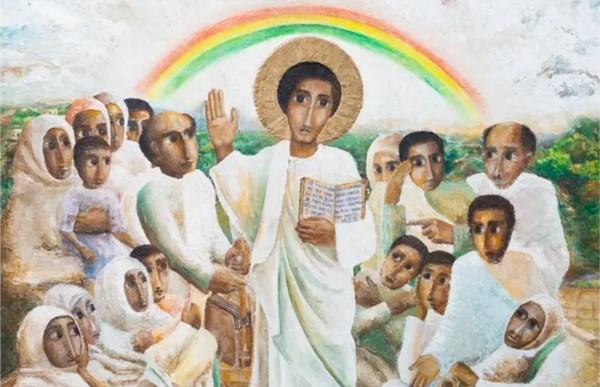
To commemorate and celebrate the Jubilee Year 2025, CAFOD and the Bishops’ Conference of England and Wales commissioned a Jubilee icon, which you can see above. It was created by Mulugeta Araya, an Ethiopian artist, based at St Mary’s College, Wukro, in the north of Ethiopia.
Ethiopia is home to one of the oldest Christian traditions and has a strong tradition of iconography, and it reminds us that this is a global Jubilee. We have much to learn from communities in countries such as Ethiopia about how to live the Jubilee message of hope, and the need to care for God’s creation and each other.
An icon is a visual aid for reflection and discernment, so this image – with Jesus at its centre, reading the text from Isaiah as outlined in Luke 4 – reminds us that in all that we do, Jesus is the centre; it reminds us that we are following his call.
Let’s look at the text it depicts (Luke 4:16-19). Prior to this moment, Jesus had been in the desert for forty days where he had been put to the test by the devil.
'When he came to Nazareth, where he had been brought up, he went to the synagogue on the Sabbath day, as was his custom. He stood up to read, and the scroll of the prophet Isaiah was given to him. He unrolled the scroll and found the place where it was written:
"The Spirit of the Lord is upon me,
because he has anointed me
to bring good news to the poor.
He has sent me to proclaim release to the captives
and recovery of sight to the blind,
to set free those who are oppressed,
to proclaim the year of the Lord’s favour."'
This text is his ‘manifesto’ – his statement of purpose. It draws on the Old Testament tradition, particularly Isaiah, the book that talks most about the coming of the Messiah. The ‘year of the Lord’s favour’ means a Jubilee year, just like the one we are in now, so we would do well to reflect on what Jesus was setting out to do and inviting us to do, too.
In the icon we see Jesus in the midst of a crowd. They are transfixed on him, but he is looking at us, speaking to us, calling us to follow him and join him in this work of bringing good news.
Bringing good news
‘Good news to the poor’: what is that? Coming to know Jesus, yes, but how about food? The end of war? The return of rain?
I think of some of the people I met recently in in South Sudan who, through the work of CAFOD and its partners, had received the ‘good news’ they needed. The Sudanese refugee who has a small meal every day because of the commitment of Caritas in the Diocese of Malakal. The community who celebrated the building of a fish processing plant (with solar powered freezers!). The women who were excited to start saving together, supporting one another in making daily sacrifices in order to do so.
Sr Elena, who I also met there, reminded me that in doing this work, we – CAFOD and our partners – were being Christ to the local people, bringing good news.
Is responding in this way to those in need really what we are called to do? (And by ‘we’, I mean not just CAFOD as an organisation, but all of those who support us, making sacrifices of their own to do so. Those sacrifices, such as those made on Family Fast Days, are an important part of the expression of solidarity as well as being vital in raising funds for CAFOD to respond quickly and keep going.)
Well, quite simply, yes! And Pope Leo has emphasised this in his first exhortation, Dilexi te.
Love for the poor
The person with a stick at the front of the icon shows Jesus’s concern for those who are often overlooked in our society, such as the elderly, vulnerable and those living with a disability.
God's heart breaks for the vulnerable and marginalised, and inspires our hearts to be similarly broken, so that we might open them to others. We hear those calls throughout the Old and New Testaments. Pope Francis reminded us: ‘The Gospel is a word of compassion; it calls us to exercise charity, to forgive our neighbour’s debts and to be generous in serving others.’
Of course, CAFOD seeks to respond to those in need in times of emergency and war, but also in the longer term – we promote, for example, sustainable farming techniques, business development and housing projects. We also show compassion when we support communities in campaigning for change locally, and join in a global call for a more just and peaceful world.
Pope Leo reminds us of the centrality of care for the poor in our faith: ‘Love for the Lord, then, is one with love for the poor’ (Dilexi te §5). However, he observes that as important as almsgiving is, we are also called to tackle the causes of poverty, because the poor are not in that position by chance or fate.
In this Jubilee year, forgiving debts is a real opportunity to make a difference. In a world where the focus is often on those with the power, Jesus reminds us of the need for societies to care for those who are neglected by societies, just as, before him, the prophets raged at how the widows and the orphans (who would be destitute) were treated.
So it is about individual compassion, for sure, but the year of favour was a social thing: the whole of society allowed time for the earth to recover, repaid debts and reset relationships.
CAFOD’s debt campaign offers real structural hope for people, especially at a time when international development assistance from governments is being cut back (incidentally, this was the subject of almost every conversation I had when I was in South Sudan). It’s part of a global campaign across the whole Caritas family (the network of Catholic relief and aid agencies) to turn debt into hope.
Currently 54 countries are in debt distress, which means more is spent on debt repayments than on health or education. This affects around 3.3 billion people. Cancelling debt would have the impact of easing burdens and inspiring hope in billions of people. All of this is possible.
For the millennium Jubilee in 2000, the campaign for debt relief secured more than $130 billion of debt cancellation. Instead of paying crippling interest bills to banks, communities around the world had more money to spend on health, education and preparation for environmental disasters caused by the climate crisis. We were successful then, and we have the opportunity to be successful once more. Yes, it is complicated, and the debt crisis is different now, but there is growing global momentum. Pope Francis set up a commission of expert economists who reported in June, and Pope Leo has met with them.
A Jubilee year reminds us that it’s not just about words, but action. As pilgrims of hope this year, each of us has the power to put hope into action, one simple step at a time. Whether it’s by giving, acting or praying – as individuals or communities – we can each build hope: ‘When the Church bends down to break the new chains that bind the poor, she becomes a paschal sign’ (Dilexi te §61).
The option for the poor
On the icon, you can see that Jesus’s right hand is raised to show that he is teaching. How do we learn, and who do we learn from? I think that in our giving, acting and praying, and our conversations with others, we are teaching others about the love of Christ by example.
There is nothing more off-putting than people who say one thing and do something else. That hypocrisy is a kind of oppression, too, and also the thing that Jesus most often gets angry about – how the religious (and political) leaders of his day created huge burdens for people to carry through their requirements, while they forgot about the Lord of compassion and love that the prophets spoke of, the heart of the Law.
Jesus’s best-known parable is probably that of the Good Samaritan. We are all familiar with its message: the man who was the neighbour to the injured man was the one who showed mercy. But he, the Samaritan, was the enemy of the Jewish people; the lawyer (who sought to test Jesus with the question to which the parable is an answer) couldn’t even bring himself to utter their name. But Jesus storms right through it. Mercy, not legal stipulation, is the point.
The gospel calls us to exercise charity, to forgive our neighbour’s debts and to be generous in serving others as we seek to build the kingdom of God. This is at the heart of Jesus’s teaching, and consistently conveyed in the Old and New Testaments.
A Jubilee is that special time to stop, understand again what God intends for all of us, and to think about how we bring that love and hope of God to others. In the 1960s, the Catholic Bishops in Latin America illuminated a concept in Catholic Social Teaching that informs how we go about this – the preferential option for the poor. If our society is not equal, not yet reflecting the kingdom of God, then we are called, as individuals and structures, to be on the side of those oppressed or poor. As Pope Leo says: ‘The bishops stated forcefully that the Church, to be fully faithful to her vocation, must not only share the condition of the poor, but also stand at their side and work actively for their integral development.’ (Dilexi te §90) That inspires CAFOD today – we do what we can to stand at the side of the poor.
Starting and ending with Christ
Hope starts with Christ and this hope ripples out towards us and, through our lives, to others, as well as creation itself. We can all hold on to hope, enrich ourselves with it, but Pope Francis asked more of us: ‘During the Holy Year, we are called to be tangible signs of hope for those of our brothers and sisters who experience hardships of any kind.’
Let’s go back to the Scripture from which Jesus reads:
'The Spirit of the Lord is upon me,
because he has anointed me
to bring good news to the poor.
He has sent me to proclaim release to the captives
and recovery of sight to the blind,
to set free those who are oppressed,
to proclaim the year of the Lord’s favour.'
Bringing good news – when that good news for people is that war is over, that they have enough to eat, that their families are united, we have to be realistic that we can’t bring that. But we can offer, through our gifts, actions or prayers, a sense of solidarity – the good news of not being alone. I’ve met people who are amazed that people in countries thousands of miles away, that they have never met, care about them.
Proclaiming release to captives and setting free those who are oppressed – this is not calling us to provide ‘get out of jail free’ cards, but perhaps it is a call to free ourselves and others from things that bind us, that take us away from God, from the overconsumption in our society, from racism and discrimination, from selfishness.
Recovery of sight – whilst Jesus healed the blind, literally, perhaps we should think more about opening our eyes to what is really important, to ways in which we can change the world. The year of the Lord’s favour is, like the kingdom itself, not just ‘out there’, it is also ‘in here’ – in our own hearts, our own lives and in the witness we show. At CAFOD, whether it’s in championing our debt campaign, giving on a Fast Day, making a pledge, or praying, we witness every day what it means for our supporters be people of hope. What nurtures and encourages us through all this is Jesus. At the centre of the icon. At the centre of our lives. At the centre of our hope and our love.
As Pope Leo writes in the last line of Dilexi te: ‘Through your work, your efforts to change unjust social structures, or your simple, heartfelt gesture of closeness and support, the poor will come to realise that Jesus’ words are addressed personally to each of them: “I have loved you”.’ (§121)
Christine Allen is Director of CAFOD, the official overseas aid agency of the Catholic Church in England and Wales, part of Caritas Internationalis.
This article is based on a talk delivered at the Diocese of Arundel & Brighton’s Festival of Hope on 20 September 2025.