
Faith in the making: Creativity, calling and the long work of discernment


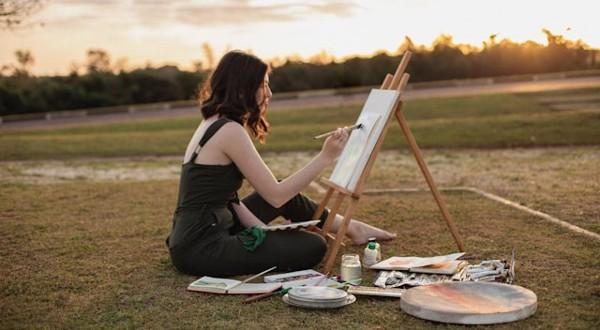
As an illustrator whose faith is integral to her work, Emma Walton speaks of the relationship between creativity and prayer as one of mutual participation, a notion which will resonate with many Christian artists. And even if you don’t have a passion for painting, you might recognise your own journey in Emma’s account, on the Things I Wish I Knew podcast, of how she learned to wait patiently for God to choose the right moment to meet her.
In some cases, making a decision can be an event, a grand, decisive moment; but in contrast, a process of discernment can often be experienced as a series of small attentions. In the life of Emma Walton, a Catholic artist and mother-of-two, that attentiveness takes the form of quiet ‘nudges’ that gradually shaped both her faith and her vocation. What emerges from her story is not a sudden conversion narrative, but a patient unfolding of trust, questioning and creative response. These reflections come from a conversation with Julia Corcoran in the latest episode of Things I Wish I Knew.
Emma’s early years were shaped by a blend of Anglican and Catholic influences, alongside a broader cultural Christianity that was present but not always deeply examined. Like many young people, Emma experienced her teenage years as a period of exploration. She began to move from inherited practice towards personal conviction, seeking a more intentional relationship with Jesus. Faith, at this stage, was less about settled identity and more about questions forming in real time.
A significant turning point came during her university years, when she met her husband. Their differing Christian backgrounds introduced both challenge and opportunity. Rather than settling into assumptions, they found themselves having to articulate what they believed and why. In that shared space, faith became something discussed, tested and slowly deepened. It was not a straightforward alignment, but a gradual mutual learning.
One of the most striking moments in Emma’s journey occurred during a trip to Kefalonia. While there, she encountered a Catholic icon that drew her in with unexpected force. The experience was not simply aesthetic appreciation, but something more interior and disquieting. She describes it as a kind of awakening desire, a pull towards understanding a tradition she had not previously explored in depth. That moment became the catalyst for a new search.
On returning home, Emma felt compelled to learn more about the Catholic Church. This led her to contact a local parish, beginning a process of inquiry that was both exciting and unsettling. Yet the path forward was not immediate. Alongside her growing interest, there were practical and relational questions, including the importance of her husband’s own journey and the need for shared discernment within their marriage.
What followed was a period of waiting that required patience rather than momentum. That waiting, which lasted around two years, became its own form of spiritual formation. Emma describes it as a time of interior wrestling, marked by uncertainty but also a persistent sense that she was being guided rather than abandoned. It was not a passive pause, but an active holding together of desire and restraint, trust and hesitation. In hindsight, it is precisely this period that gave depth to her eventual decision.
The moment of movement came unexpectedly, through an email from a priest. What might have seemed incidental became, for Emma, a point of clarity. It did not resolve every question, but it opened a door that had previously felt closed or distant. She experienced it as confirmation that the direction she had been sensing was not self-generated and solitary, but accompanied. That sense of accompaniment mattered as much as the practical next step.
Emma’s eventual reception into the Catholic Church did not mark an ending, but a continuation of her search in a new key. Alongside her faith, she had already been developing her skills as an artist, and over time these two dimensions of her life began to interweave more consciously. She speaks of creativity not as separate from prayer, but as something that participates in it. In the act of making art, she experiences a form of attentiveness to God that is both embodied and contemplative.
This integration of faith, creativity and family life has become central to her vocation. As a mother, she navigates the ordinary demands of domestic life while also holding space for artistic practice. Rather than seeing these as competing pressures, she describes them as mutually shaping. Creativity becomes a way of articulating faith, while motherhood grounds it in the everyday rhythms of care and presence.
At the heart of Emma’s story is a quiet theological intuition – that God is not only encountered in dramatic turning points, but also in sustained attentiveness over time. The ‘nudges’ she describes are rarely forceful. They require interpretation, patience and the willingness to remain open even when clarity is elusive. Her experience suggests that vocation is less about sudden arrival and more about faithful responsiveness.
There is also a notable generosity in the way Emma speaks about others who are still searching. She resists the idea of a single pathway to God, instead emphasising the breadth of human experience and the varied ways people come to faith. Her encouragement is understated but significant: begin where you are, whether in prayer, curiosity, or creativity, and allow that beginning to take shape over time.
In that sense, Emma’s story is not only about Catholic identity or artistic vocation, but about the broader human task of learning to listen. It is a reminder that discernment often involves long stretches of uncertainty, where meaning is not immediately apparent, yet is still forming beneath the surface.
Listen to ‘Things I Wish I Knew About the Quiet Nudges of God’ and to get all of our new episodes and catch up on our back catalogue, subscribe now >>
You can follow us on Instagram: @tiwik_pod.