
Daniel Berrigan’s homage to Gerard Manley Hopkins


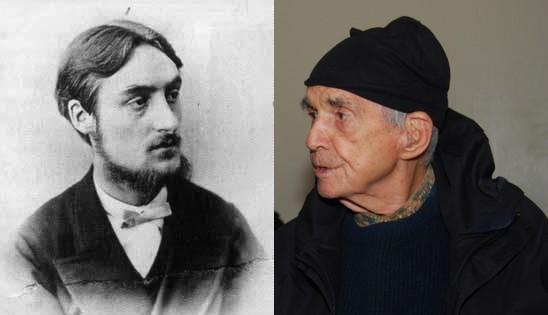
(Photo of Daniel Berrigan by Thomas Good shared via Creative Commons [CC BY-SA 4.0])
A London-born, nineteenth-century classicist might have been surprised to learn how profound an impact he would have on the life of a peace activist who grew up in New York and was arrested multiple times before his death in 2016. The Hopkins Society’s Philip Healy reveals the deep admiration of one Jesuit priest-poet for another.
On the face of it, Daniel Berrigan (1921-2016) and Gerard Manley Hopkins (1844-1889) seem an ill-assorted pairing, but not so to Berrigan. The modern American looked to the Victorian Englishman and saw a fellow Jesuit and fellow poet. Berrigan admired what he saw, and paid homage in a sequence of poems addressed to his precursor.
At first there are similarities between the two men. Both enter the Jesuit novitiate as young men and follow the conventional Jesuit pathway: spiritual formation, study of philosophy and theology, a spell of teaching in Jesuit schools, ordination, and a final period of spiritual formation (tertianship). Berrigan spends his tertianship in 1953-54 in Paris, where he encounters the Worker Priest movement, a radical but short-lived experiment in social Catholicism in which priests took manual jobs in factories and lived alongside their fellow workers in working class districts, playing an active political part in them. This was an eye-opener for Berrigan.
At this stage in Berrigan’s career, the similarities with Hopkins are still evident. Berrigan discovers a powerfully strong poetic voice. On being shown some of Berrigan’s poems by a publisher, the distinguished American poet, Marianne Moore (1881-1972) recognises his gift. Berrigan’s first book, Time Without Number is published in 1957 to acclaim and goes on to win the Academy of American Poets’ prestigious Lamont Poetry Prize for that year.
A brief sketch of Berrigan’s long life, however, immediately throws up the many disparities between the two men. The Vietnam War radicalised Berrigan. When a young member of Dorothy Day’s Catholic Worker Movement immolated himself in front of the United Nations building in New York in protest at the war, Berrigan celebrated a requiem Mass and preached a sermon which led to his Jesuit superiors exiling him to Latin America. This almost certainly served to radicalise him further. In 1967, outside the Pentagon, Daniel Berrigan SJ was the first priest in US history to be arrested for protesting against the war. But this was just the beginning. In 1968, at the height of the Vietnam War, Berrigan and the radical historian, Howard Zinn flew to Hanoi on a peace mission, returning with a number of US prisoners of war. Whilst there, they experienced firsthand in a shelter a US bombing raid. In the wake of this and the assassination that year of Dr Martin Luther King, Daniel, his brother Philip (also a priest) and several others (known collectively as the ‘Catonsville Nine’) removed draft files (call-up papers) from the draft board office in Catonsville, Maryland and set fire to them in the car park with home-made napalm. They were arrested, tried and given prison sentences. Berrigan went on the run, but was re-arrested and imprisoned. While awaiting his sentence, he wrote a play based on the trial – ‘The Trial of the Catonsville Nine’ – which was performed on Broadway and turned into a film.
Berrigan was now a committed peace activist. In 1980, he, his brother and others in the ‘Plowshares Eight’ group were arrested for breaking into the General Electric missile plant at King of Prussia, Pennsylvania and striking an unarmed nuclear warhead with a hammer. (At the time of writing here in the UK, we have seen a similar act at RAF Brize Norton, which was broken into in 2025 by members of Palestine Action, who went on to cause several millions of pounds’ worth of damage to two planes by pouring red paint over their engines. This in turn led to the proscription by the government of Palestine Action as a terrorist group. Since then several hundred protestors have been arrested for displaying posters of support for the proscribed group at demonstrations against the Israeli bombing of Gaza.)
It was in 1980 that Berrigan made his first visit to Northern Ireland, which was then embroiled in the Troubles. In 1984, he began pastoral ministry at St Vincent’s Hospital, New York, working with people with AIDS. He acted as consultant in the making of the film, The Mission (1986), directed by Roland Joffé, with screenplay by Robert Bolt, and starring Robert De Niro and Jeremy Irons. The film is set in eighteenth-century Paraguay where the Jesuit missionaries helped the native Guarani set up a protective territory against the colonial assaults of the Portuguese. Berrigan himself had a brief cameo role in the film.
In the latter part of his life, Berrigan was able to put his long experience of peace activism to exegetical use in a series of commentaries on the prophets of the Old Testament. He continued writing poetry. And in 1993 he published Homage to Gerard Manley Hopkins, a 59-page sequence of untitled poems loosely structured around Hopkins’s biography.[i] The epigraph of the sequence is from the medieval Franciscan poet, Jacopone da Todi: ‘Ordina questo amore, O tu che m’ami’ (‘Set your love in order, you who love me’ – Laude XC).
I managed to find and purchase a copy of the book online some years ago. Mine is an ‘association copy’, signed by Daniel Berrigan and two other Jesuits, with messages of thanks for his hospitality to Fr Senan Patrick Timoney SJ (1945-2013). The three American Jesuits had visited Belfast in August 1999, just over a year after the Good Friday Agreement brought an end to the Troubles. They had stayed with Fr Timoney, who was then Superior of the Jesuit residence in Belfast. No doubt, Berrigan and his two fellow American Jesuits wanted to see firsthand how the peace agreement was working out.
For all their differences, Berrigan clearly sees Hopkins as his companion, in the writing of poetry and in their common Jesuit life. He recognises that Hopkins led an almost hidden life as a Jesuit – only to emerge years later as one of the best-known members of the order:
What make of you, elusive, unto yourself, only half in
what we (factitious alas, flat)
name ‘real,’ name ‘world.’
And you? ‘incompetent’ it was said,
and ‘low in spirit,’
(how misery loves the Company!)
You died so, sighing.
Then
years and years gone, against all odds –
of our high toned enclave
you, surprise, the prize! (p.11)
Berrigan cherishes the modesty, the quiet, understated life of Hopkins’s commitment to his vows to follow Christ. In his lifetime, Hopkins showed no ambitious will to attract the notice and applause of the world. Given how some of his Jesuit superiors would have regarded as unwelcome the notoriety that Berrigan’s social activism attracted, perhaps he felt a bond with Hopkins who was all but invisible to his contemporaries; yet both Jesuits were faithful to the Lord, in their fashion.
Your life, its turmoils, fits and starts,
intelligence passionate, tentative
as blind hands upon a garden flower,
your quest,
quixotic, after Christ –
how truly said
and duly signed by you, and all
by indirection, imagination –
Jesuits need not wield
scientific, mathematic,
philosophic blunderbusses –
a narrowing, harrowing scope! (p. 2)
Berrigan’s poem sequence is, of course, an homage to his Jesuit poet predecessor, and he best demonstrates that by interleaving Hopkins’s poetic diction with his own. Berrigan is standing on the shoulders of his own personal giant.
What you took seriously
(Therefore,
a bronze hinge
opened majestically)
stars, springtime,
a candle indoors,
kingfishers,
dragonflies,
all beseeching
‘O speak for us!’ –
you laid on each
the strange searching stigma of imagination.
The achieve of, the mastery
who knows how? stands. (p. 35)
Berrigan the poet has been Hopkins’s student. But he is also the social justice activist, and he is struck vividly by how Hopkins sees justice in the world. Berrigan links justice in Hopkins with Christ’s emptying of self, which in turn allows for the recognition of the other. For Berrigan, Hopkins handles this relation of justice with the other with great poetic sensitivity, and thus captures in his verse a matter of great importance.
Dwelling long among your themes
praise, I think
becomes you most. Kenosis of self
breaking the cup,
repairs, fills it the more, that Other.
Splendors press,
lowly things linger –
fishes, finches,
stones, bells, tucks of string –
creatures of upper air,
near nothings.
Then to the leap, the just man justices.
Who in mind’s eye
strung them, what theme
hung them, a necklace
about Christ?
It was a feat
nice to nuance and substance.
The poet, disclaiming praise
heaping it high, hymning
that beloved Other
only
owns it the more. (p. 40)
Hopkins, we know, had strong political views – typical of his class and education. He detested Gladstone’s political line, which included, of course, Irish Home Rule. Despite that, he had the empathy and intelligence to see the poverty and distress in Ireland once he was sent there by his Jesuit superiors. Berrigan, who also, of course, had strong political views, although perhaps less complex than Hopkins’s, wants to take this ideological contrast head-on and explore what it might mean for his regard for his fellow Jesuit poet. He takes quotations from two of Hopkins’s letters as his point of departure – one, Hopkins’s famous ‘red’ letter to Robert Bridges (which almost caused a rift in their friendship), and the other an example of Hopkins’s late Victorian jingoism.
Whether for the moment
iconoclastic –
‘Horrible to say, I am in a manner a communist
or to the core chauvinist –
‘British freedom
is best, the only successful freedom’ –
nevertheless
a deeper vein
stuck by shrewd discipline
yielded
good sense, compassion.
In foul doorways
standing helpless, tragic faces wrung you,
won you over –
no availing, no
thwarting
the high and mighty
whip-lash, sword –
yet
tears wove
immortal garlands for tormented brow
of Tom,
for dying Felix Randall. (p. 45)
The high regard and admiration with which Berrigan regards Hopkins the poet is permeated by love – a love which draws its force from their shared commitment to follow Christ.
Gerard, I pray
(your crown of thorns
by Christ transfigured –
laurel, aureole, leaf of gold)
No base emulation
mar my love! (p. 59)
In confessing this love, Berrigan admits that Hopkins is il miglior fabbro.
Philip Healy is Treasurer of the Hopkins Society and Emeritus Fellow of Kellogg College, Oxford University.
This article was first published in The Hopkins Society Journal 45 (2025/26) and is republished with kind permission of the Hopkins Society: https://hopkinssocietyuk.co.uk/
[i] Daniel Berrigan SJ, Homage to Gerard Manley Hopkins (Baltimore: Fortkamp Pub. Co, 1993).