
The Annunciation of the Lord: What does the liturgy teach us?


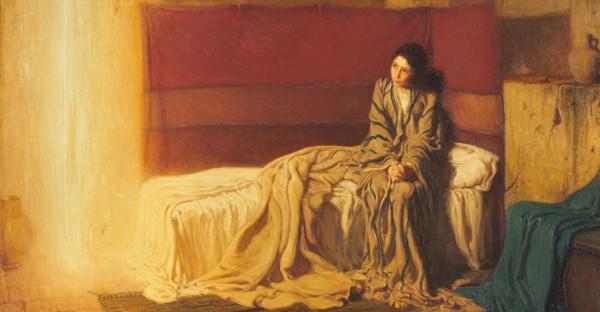
The texts that shape our liturgical celebration of the Annunciation on 25 March ‘invite us into the mystery of Christ’s incarnation in the womb of the Virgin Mother’, says Luke Taylor SJ. In pondering their words, we can find our own place in the ongoing story of salvation which is animated by Mary’s ‘yes’.
Every year on 25 March, the Church solemnly celebrates the Annunciation to Mary of the Lord’s birth. What does this feast show us about Christ? What does it show us about Mary? And what does it show us about ourselves? In what follows, after very briefly sketching the history of the feast, I answer these questions in turn. In tracing the theology (lex credendi) encoded by the liturgy of the missal, lectionary and Divine Office (lex ordandi), we find ourselves invited into the mystery of Christ’s incarnation in the womb of the Virgin Mother.[i]
The incarnation has been associated with 25 March since at least the third century. The basis of this association may have been originally seasonal: it was thought fitting that Mary’s baby be born on the winter solstice of 25 December, after nine months of maturation from the beginning of spring on 25 March.[ii] We may also here touch a historical memory reaching all the way back to Bethlehem and to Calvary: the tradition that the Son took flesh on the same day that he died.[iii] In any case – whether historical, fitting, or both – we see the introduction of the feast into the Church’s calendar by 550 in the liturgy at Constantinople, and by 660 in the papal liturgy in Rome.[iv]
Jesus: Promised king, divine Son
Following the Hebrew day, which begins at sundown, the Divine Office for the Annunciation begins with prayers on the evening of 24 March. They catch already the great note of promise: one is coming, written about long ago – ‘a star has risen from Jacob’, ‘a flower has sprung from Jesse’s stock’ (Responsory: see Numbers 24:17, Isaiah 11:10). In the Office of Readings for the following morning, we learn more about this long-awaited Davidic king. He is to come from David’s own ‘offspring’, but unlike earthly kings and the historical vicissitudes of the Israelite monarchy after David, ‘his throne shall be firmly established forever’ (Office of Readings; 1 Chronicles 17:14).
All of this helps us to understand the pivotal drama of Gabriel’s announcement to Mary, proclaimed in the gospel at Mass. The one who will be born to Mary will sit on ‘the throne of David his father’, and ‘will rule over the house of Jacob forever’ (Luke 1:32). In other words, the old promises are about to come true. After a long winter, the tide is on the point of turning.
The Liturgy of the Word progressively unveils an even deeper mystery: the coming son of David is also the Son of God. The first reading from Isaiah hints at this. The son to be born will be called ‘Emmanuel, which means “God is with us”’ (Isaiah 7:14). Since the beginning, Christians have recognised a prophetic depth in Isaiah’s words whose deepest application reaches beyond their original eighth-century BCE context: the Hebrew almah or ‘young, unmarried woman’, translated in the Greek Septuagint as parthenos, ‘virgin’, is finally Mary; the ‘sign’ is the true miracle of a virgin birth; and the son to be born is divine.
Taking their cue from Matthew’s Gospel (Matt. 1:23), the readings play out this central mystery in several different biblical genres or keys. The responsorial psalm, Psalm 40, is heard as a Christological lyric. The one who, as the refrain repeats, is coming to do the Lord’s will, who is written about in the scroll of the Scriptures, who proclaims the Lord in the assembly, is the Son of God: in the lector’s voice, we hear Jesus’s own voice speaking to us. This is affirmed in the second reading from Hebrews, which is a commentary and exegesis on the psalm we have just heard. The writer of Hebrews, following the Septuagint version of Psalm 40, hears a reference to the incarnation: ‘a body you have prepared for me’. Then, in the outburst of the gospel acclamation, this astounding event is explicitly announced in Johannine words: ‘The Word became flesh and made his dwelling among us!’
The Church’s understanding of the mystery of the incarnation took centuries to mature. It was adumbrated at Nicaea in 325, where Christ was declared homoousios – one in essence – with the Father against the presbyter Arius, who considered Christ to be an elevated creation. But how could Christ be both God and man? Through a messy series of negotiations which need not delay us here, the Council of Chalcedon (451) will eventually define the enduring formulation to which we still hold: Christ is God and man, perfect divinity and perfect humanity, united in one person or hypostasis. Against Nestorius, this definition clarified that Mary was not only the mother of Christ, but indeed the Theotokos, the bearer of God.
We are reminded of this orthodox teaching in the collect, where we ‘confess our Redeemer to be God and man’, and in the closing prayer, where we again confirm that the one ‘who was conceived of the Virgin Mary is true God and true man’. Furthermore, this teaching is expounded in the office of readings’ selection from the ‘tome’ of Pope Leo the Great. In beautifully balanced Latin phrases, Leo explains how Christ is ‘truly the Son of God and truly the son of man’: as God condescending, as man raising us up; the divine nature manifested in miracles, the human nature suffering injuries; incapable of death as God, capable of death as man – and so in all ways uniquely capable of becoming our redeemer.
It is surely fitting, then, that on this day as on Christmas day, when in the creed we confess that Christ was ‘incarnate of the virgin Mary’, we not only bow our heads, but bend our knees.
Mary: Blessed mother
The feast of the Annunciation is Marian because it is Christological. Here as elsewhere, the Church exults Mary highly, precisely because of her relation to the highest.
Mary is, first of all, a true earthly woman. This is the condition of the incarnation. For it is in her womb – from, in, and through Mary – that the Word takes on ‘the reality of human flesh’ (Collect). The reality of the incarnation is also emphasised in the evening prayer’s selection from 1 John: Christ has really come in the flesh: he is visible, and tangible – ‘what we have seen with our eyes… touched with our hands’ (1 John 1:1-2). What Mary bears is not a word in the air or a word on paper, but the beating heart of the Word enfleshed, a baby boy.
In the gospel, we are presented not with a passive vessel, but with a protagonist, a woman whose obedience to God passes through the questioning and doubt familiar to us in our own faith lives. Gabriel’s greeting to her – ‘Hail, full of grace!’ – fills her with consternation (‘she was greatly troubled at what was said’) and internal questions (she ‘pondered what sort of greeting this might be’). To the unthinkable announcement that she, a virgin, will give birth, she responds with an honest question (‘how can this be . . .?’). Only through this dialogue does Mary consent with her full-hearted fiat (‘be it done unto me according to your word’).
The Magnificat, the Church’s earliest Marian hymn, repeated in every evening prayer of the divine office, gains special significance on its anniversary. Mary recognises her blessedness: ‘henceforth all generations will call me blessed’ – a prophecy fulfilled in the Church. Yet we perhaps do not recognise how thoroughly Jewish her canticle is. Mary places herself amongst the small ones, the lowly for whom the God of Israel takes special care. Her words echo and fulfil the Jewish psalm we read the evening before: ‘From the dust he lifts up the lowly, from his misery he raises the poor’; ‘he hath put down the mighty from their seat, and hath exulted the humble and meek’ (Ps. 113:7; Luke 1:52).
As a Jewish woman, soaked in the tradition and Scriptures of the Jewish people, Gabriel’s prediction – ‘The Holy Spirit will come upon you, / and the power of the Most High will overshadow you’ – must have been astounding to Mary. She was being told that the shekinah glory, the presence of the Lord God, would fill her as it filled the Temple and dwelt above the Arc of the Covenant (Ex. 40:34-38). Whilst we have no direct access to Mary’s mind at that moment, we can assume that she consented in the knowledge that God was about to act in her as mightily as he had acted in Israel’s past.
This is the assumption underlying the preface of the Mass, which celebrates Mary’s faith in the promises to be fulfilled in her. ‘For the Virgin Mary heard with faith / that the Christ was to be born among men and for men’s sake . . . that the promises to the children of Israel might come about / and the hope of nations be accomplished.’ Mary’s is no merely intellectual recognition, but an affective and bodily acceptance of God into the deepest part of herself: ‘lovingly she bore him in her immaculate womb’. The Word is conceived in her, not as an idea but in her own flesh. It is in view of and through this embrace that Mary was and remains immaculate, spotless.
Faithful disciple, child of God
The preface’s reference to Christ as the ‘hope of the nations’ (cf. Matt. 12:21) indicates the universal scope of the Jewish messiah. As gentiles, we too can enter the narrative of salvation through Jesus, who is saviour of all peoples. We too can, following Mary, accept the word and promise of God. In the evening prayer, Mary’s experience is presented as paradigmatic of every subsequent disciple: like her, we are to receive God’s gracious election, his gift of salvation, joy and peace; like her, we trust that God wishes to lift us up, even – with him ‘all things are possible’ – to raise our dead to new life. In short, we pray that God will ‘touch our hearts that we may welcome Christ as Mary did’ (Intercessions).
Mary is more than our model and patron – she is also our mother. A loving and filial relationship is thus appropriately expressed in the Marian hymns of evening and morning prayer. James Quinn SJ makes explicit in his metrical English translation what remains implicit in the Latin hexameters of the Alma Redemptoris Mater – ‘Loving Mother of the Redeemer’: the one who gives us Jesus, the fruit of her own body, is also our own mother in the order of grace. Just as she nurtured and cared for him on earth, so she continues to nurture and care for us from heaven.
The sense that our own salvation hangs upon Mary’s ‘yes’ likewise illuminates the present-tense address to Mary in the hymn for the office of readings: ‘Rejoice, O Virgin Mary’. Taking the part of Gabriel, we enter into the scene, repeating the promises and injunctions: fear not, you have found favour; ‘he has made you mother of his only son’. As with all the mysteries of our salvation, the annunciation is in one sense past and complete, but in another happens to us now. In speaking to Mary, we also speak to ourselves; the salvation which came to her is truly the salvation coming to us.
At the annunciation, through Mary, in Jesus, we become sons and daughters of the Father. We become – truly, really, properly – children of God. Our new identity is unsurpassably daring. Indeed, we might not dare to think it were it not taught by the Scriptures. In both evening and morning prayer, we read of the parabola of divine humility: Jesus’s downward, self-emptying kenosis results in his upwards exaltation above every name (Phil. 2:6-11). And all of this was for us. Descending into unity with us, Christ also assumes us with him. The divine parabola is, in other words, at the same time a human-divine chiasmus: Christ assumed our human nature, in order that we might participate in his divine nature (see 2 Pet. 1:4). So when in the morning and evening prayer we ask God that we may ‘become more like Jesus Christ’, we ask to become more fully what through grace we already are.
Luke Taylor SJ is a Jesuit of the British Province studying theology in Boston College.
[i] Quotations are from the English translation of the Roman Missal approved for use by the United States Conference of Catholic Bishops (USCCB) in 2010; Lectionary for Mass, vol. 1, ‘Sundays, Solemnities, Feasts of the Lord and the Saints’ (New Jersey: Catholic Book Publishing Co., 1998); and The Liturgy of the Hours, vol. 2, ‘Lenten Season, Easter Season’ (New York: Catholic Book Publishing, 1976).
[ii] Ignazio M. Calabuig OSM, ‘The Liturgical Cult of Mary in the East and the West’, in Handbook for Liturgical Studies, ed. Anscar J. Chupungco, vol. V ‘Liturgical Space and Time’ (Liturgical Press, 2000), p. 256.
[iii] Matias Augé CMF, ‘The Liturgical Year in the Roman Rite’, in Handbook, vol. V (2000), p. 195.
[iv] Calabuig, ‘The Liturgical Cult of Mary’, in Handbook, 263. For a fuller account see C. Maggioni, Annunciazione. Storia, eucologia, teologia liturgica (Rome, 1991), pp. 30-73.