

Is it enough to be peaceful?


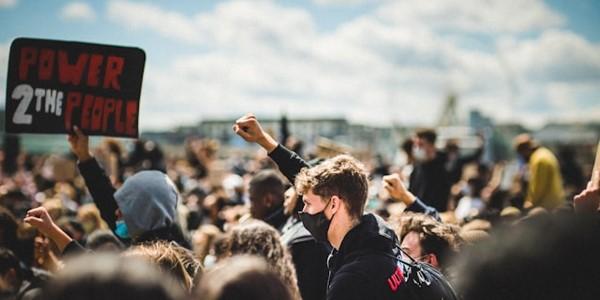
The level of police restriction on the actions of protesters is not just determined by whether a gathering is obviously peaceful or violent in nature, explains Patrick Riordan SJ. In fact, a complex mix of the rights and obligations of individuals and authorities, which are addressed in secular and church documents, makes the question of if and when to intervene a delicate one.
When are peaceful protests no longer tolerable? Does the truth of the matter, the seriousness of the issue, such as famine in Gaza or climate change, justify major public disruption by protesters? Does the strength of feeling expressed by demonstrators entail that damage to or destruction of property can be overlooked? Under what circumstances is a restriction of the right to protest an infringement of a protected right? Many of these questions provoked by recent protest actions are raised in debates, whether in the media, in parliament or in the courts. They arise also in the conversations of concerned citizens.
There is an alleged flaw in the European Convention on Human Rights (ECHR, 1950), namely that it is one-sided in its promotion and protection of the rights of individuals, elaborating on the earlier Universal Declaration of Human Rights (UDHR, 1948). The supposed flaw is that the asserted rights of individuals are not balanced by corresponding duties linked with the exercise of those rights, not only that one should not interfere with another’s exercise of their rights, but more importantly, that one should not damage the social and political fabric that secures the context for the exercise of those rights. The missing balance is more than the neglect of individuals’ duties. It is also the absence of clarity concerning the obligations of civil authorities to secure and protect public goods, along with their responsibilities to uphold individuals’ rights.
This alleged imbalance is understandable, since the context of the drafting of the Convention was the desire to ensure limitation on the powers of states to restrict personal freedoms, given the horrific experiences of Naziism, Fascism and Communism, which had been oppressive of their own citizens in the name of some supposedly higher value such as national destiny or the global proletarian revolution. The protection of individuals from unwarranted intrusive state action was foremost in the minds of the drafters.
And yet, it is not the case that these foundational human rights documents completely overlook the obligation of civil authorities to constrain the exercise of rights when necessary. They do indeed outline, admittedly sometimes in vague terms, what circumstances might necessitate the limitation of rights. Some rights are absolute: the right not to be tortured is not qualified (UDHR Art.5), neither is the right not to be subject to slavery or servitude (Art.4). These are formulated in the negative form: ‘No one shall be subjected to…’. However, other rights with this formulation have a built-in qualification, as: ‘No one shall be subjected to arbitrary arrest…’ (Art.9). That word ‘arbitrary’ opens up the space for consideration of the conditions when arrest would not be arbitrary, but warranted.
Other rights that are formulated positively – ‘Everyone has a right to life, liberty, and security of person…’ (Art.3) – are assertive, and while they are declared to be inalienable, they are not absolute. Article 29 of the UDHR specifies that:
1. Everyone has duties to the community in which alone the free and full development of his personality is possible.
2. In the exercise of his rights and freedoms, everyone shall be subject only to such limitations as are determined by law solely for the purpose of securing due recognition and respect for the rights and freedoms of others and of meeting the just requirements of morality, public order and the general welfare in a democratic society.
3. These rights and freedoms may in no case be exercised contrary to the purposes and principles of the United Nations.
Art.29 (1) makes the point about rights-holders’ duties towards society. Art.29 (2) lists the conditions for the limitation of the exercise of rights. Art.29 (3) expands the range of ‘society’ to include the UN.
Reasons warranting limitation of rights are summarised in (2). Limitations may only be imposed according to law, which has one or more of four purposes: (i) ‘securing due recognition and respect for the rights and freedoms of others’; ‘meeting the just requirements of [ii] morality, [iii] public order and [iv] the general welfare in a democratic society’.
The ECHR, whose full title is Convention for the Protection of Human Rights and Fundamental Freedoms (Rome, 4.XI.1950), tends to include the conditions of limitation of the rights within each article. The conditions echo the formulations from Art.29 (2) of the UDHR, for example ECHR Art.10 (2) on freedom of expression formulates it thus:
2. The exercise of these freedoms, since it carries with it duties and responsibilities, may be subject to such formalities, conditions, restrictions or penalties as are prescribed by law and are necessary in a democratic society, in the interests of national security, territorial integrity or public safety, for the prevention of disorder or crime, for the protection of health or morals, for the protection of the reputation or rights of others, for preventing the disclosure of information received in confidence, or for maintaining the authority and impartiality of the judiciary.
The formulations of the conditions under which rights may be restricted are vague, and general, and may also reflect time-conditioned thinking when terms such as ‘utility’ or ‘general welfare’ are employed, implying a utilitarian perspective that assumes the benefits to some persons or groups can be balanced against losses suffered by other persons and groups.[1] Similarly, use of the terms ‘morals’ and ‘morality’ can be vague and misleading. But like the more concrete terms employed in the documents, such as the qualifications to ECHR Art.9 (2) on freedom of religion – ‘the interests of public safety, for the protection of public order, health or morals, or for the protection of the rights and freedoms of others’ – the specification by legislatures and determination by courts relies on debate, in which varying positions may be represented.
Such debates are not helped but hindered when rights are presented as if they were absolute, simply asserted without admission that there may well be reasonable grounds for limiting them and that every society needs to form a view on how and when to limit their exercise according to law. Noticeable in the formulations of the ECHR, but not of the UDHR, is that ‘the prevention of disorder or crime’ is included among the legitimate grounds for limiting the exercise of rights (ECHR Arts.2 [2] ‘Freedom of movement’; 8 [2] ‘Private and Family Life’; 10 [2] ‘Freedom of Expression’; 11 [2] ‘Freedom of assembly and association’).
A protest or demonstration described as peaceful will normally not rely on violence against persons with the use of weapons, but can obstruction to the exercise of ‘the rights and freedoms of others’ also qualify as violence? Is it a form of violence to deny other people their range of freedom of action? Such questions are provoked in our debates, but they may not be relevant. How a society answers them is not what determines its response to a protest. In dealing with the question of when authorities acting according to law may restrict the exercise of the rights of protesters, the human rights documents specify a range of legitimating purposes. Whether an assembly, an expression or a protest is peaceful or violent is not considered as a criterion for warranted restriction, although obviously violence will not be tolerated. The point is that the peaceful nature of a protest does not provide an exemption from the concerns for the prevention of disorder or crime, for support for public order, and for giving due recognition and respect for the rights and freedoms of others.
The human rights documents cited here date from 1948 and 1950. The Catholic Church embraced the language of human rights in the 1960s, notably in Pope John XXIII’s 1963 encyclical Pacem in terris, ‘Peace on Earth’, and in the documents of the Second Vatican Council. In December 2025, we will celebrate the sixtieth anniversary of the promulgation of two of the most significant documents to come out of the Council, the Pastoral Constitution on the Church in the World Today, Gaudium et spes, and the Declaration on Religious Liberty, Dignitatis humanae.
There will be opportunity to explore and unpack the riches of these documents. Here I focus on the issue arising from our experienced tension in current affairs between the right to protest and the obligation of civil authorities to restrict by law the exercise of that right in certain circumstances. Pacem in terris marks a breakthrough in papal teaching because of its wholehearted embrace of human rights, which are listed and elaborated. In danger of being overlooked, however, is the equal attention paid to duties, which in a parallel section are also listed and elaborated. Along with the rights they enjoy, persons in society are said to have duties towards their neighbours who should enjoy the same rights, but they also are said to have duties towards the community.
Vatican II’s Declaration on Religious Liberty is also revolutionary in church teaching in acknowledging that the entitlement to liberty is based in human dignity, and not as previously had been the case, in truth. The previous doctrine would have considered that error would negate the liberty. Now the Council teaches that religious liberty is to be respected, regardless of the truth of the convictions embraced. Accordingly, the UDHR deals fundamentally with the nature and source of rights.
The responsibility of public authorities to promote and protect rights is acknowledged both in Dignitatis humanae and in Gaudium et spes, but the former also devotes many words to the responsibility of civil authorities to protect and facilitate ‘the inviolable rights of the human person’ because of their responsibility to secure society’s common good as the set of conditions that enable people to pursue their ends (Dignitas humanae [DH] §6). The subsequent paragraph admits that it may be necessary on occasion to restrict the exercise of rights, including the right to religious liberty. The Declaration repeatedly mentions ‘the just demands of public order’ (§§2,3,4). Paragraph 7 is the most elaborate passage on what ‘public order’ entails. Mentioning the need for regulatory norms, the text first invokes the personal and social responsibility of each person to respect the rights of others. In addition, they have duties towards the common good. Then the passage proceeds to the rights of society and the obligations of civil authorities to uphold public order.
Furthermore, since civil society has the right to protect itself against possible abuses committed in the name of religious freedom, the responsibility of providing such protection rests especially with the civil authority. (§7)
Along with the protection of the rights of all citizens, the civil authority should protect ‘public peace which is to be found where people live together in good order and true justice’ (§7). Social harmony and just relations make for public peace, which the UDHR summarises as ‘public order’. The paragraph concludes with a resounding affirmation of the principle that ‘people’s freedom should be given the fullest possible recognition and should not be curtailed except when and in so far as is necessary’ (§7).[2]
There is an amazing coherence between the UDHR and the ECHR on the one hand, and the Vatican Council documents on the other. The texts, both secular and religious, suggest that the issue is not whether any particular protest action is peaceful, but whether it is necessary to restrict the exercise of liberties in order to preserve public order and to prevent crime. Any restriction must be according to law, and hence there is a need for wide public debate about what the law should be and how it should be applied. These authoritative sources provide a helpful framework for this public debate.
Patrick Riordan SJ is Senior Fellow in Political Philosophy and Catholic Social Thought at Campion Hall, University of Oxford. He is the author of Human Dignity and Liberal Politics: Catholic Possibilities for the Common Good (Washington, DC: Georgetown University Press, 2023) and co-editor, with Gavin Flood, of Connecting Ecologies: Integrating Responses to the Global Challenge (Abingdon, Oxon: Routledge, 2024).
Read more about the sixtieth anniversary of the Second Vatican Council’s Declaration on Religious Liberty, Dignitatis humanae >>
[1] John Finnis, Natural Law and Natural Rights (Oxford: Clarendon Press, 1980), pp. 210-218.
[2] Cited from the edition of Vatican Council II: Constitutions, Decrees, Declarations, edited by Austin Flannery. (Dublin: Dominican Publications, 1996), p. 558.