
Christmas Week 2


Peter Edmonds SJ refelects on the readings for the second week of Christmas.
1 January, Mary, Mother of God: World Day of Peace
Numbers 6:22-27; Galatians 4:4-7; Luke 2:16-21
As for Mary, she treasured all these things and pondered them in her heart. (Luke 2:19)
As we begin a new year, it is good to commit to memory the blessing which Moses, in obedience to God, instructed his brother Aaron to pronounce over Israel. ‘May the Lord bless you and keep you. May the Lord let his face shine on you and be gracious to you. May the Lord uncover his face to you and bring you peace’. In 1967 Pope Paul VI established the World Day of Peace, inspired by the encyclical Pacem in terris of his predecessor, Pope John XXIII, and his own encyclical Populorum progressio.
We also hear today from Paul’s letter to the Galatians the only mention in Paul’s letters of the birth of Jesus: ‘God sent his Son, born of a woman’. God had given the Jews the Law on Mount Sinai. This Law had taught them to recognise what was wrong, but did not provide the means to overcome it. God’s remedy was to send his Son, born of a woman. God could not have given us a greater blessing.
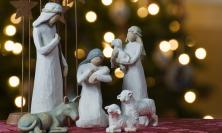
We close Christmas week by returning to the Christmas crib. Again we meet the shepherds; we meet unnamed bystanders. We meet Mary, to whom we dedicate this day as Mother of God. The shepherds come, see, praise God and disappear. The bystanders, astonished, like the shepherds, disappear. Mary treasured these things and pondered them in her heart. In the gospel story, Jesus praises her for hearing the word of God and keeping it. We welcome her into our company this new year.
Prayer
Father, we begin this new year asking for a blessing as we join the shepherds , praising and glorifying God. We treasure and ponder these truths of Christmas in our hearts as Mary did. May this day be a day of peace. We ask this through Christ our Lord.
2 January: John the witness
1 John 2:22-28; John 1:19-28
‘Why are you baptising if you are not the Christ, and not Elijah, and not the prophet?’ (John 1:25)
This first week of the year puts us in mind of other first weeks in life, whether this be our first week of school, our first week in a new job, our first week in any life situation. This week in our liturgy, we learn about the first week of the public ministry of Jesus, as reported in John’s Gospel. On this first day, we meet the one who introduces Jesus, John the Baptist. We might well call him John the witness.
Challenged to give his identity, he issued three denials, denials which bring us into the atmosphere and expectations of those days. He denied that he was the Christ, meaning an anointed one like King David of old. He denied that he was Elijah, the ancient prophet who had been carried up to heaven in a chariot of fire and was expected to return. He denied that he was ‘the prophet’, that is the prophet like himself whose coming Moses had promised. Positively, John claimed to be the voice of whom Isaiah had spoken. He was the voice who was to proclaim the Word, who was Jesus.
The story that the gospels relate is not only about Jesus. It is also about his disciples and followers. Their story anticipates our story, because as members of the Church, we are disciples too. John preceded rather than followed Jesus, but his activity of witnessing to Jesus is the vocation of every baptised person. All of us, however we identify ourselves, are called to be a voice of Jesus in our world and to witness to him by our lives, as John did long ago.
Prayer
Lord, help us to begin this new year well. Help us reflect on our own identity as John the Baptist did, and to understand our role as witnesses to you and to the values of your kingdom. We make this prayer through the same Christ the Lord.
3 January: The Lamb of God
1 John 2:29 – 3:6; John 1:29-34
‘There is the lamb of God that takes away the sin of the world.’ (John 1:29)
Three times in the course of the Mass, the congregation joins the Presider in calling upon Jesus as the Lamb of God. These same words are repeated before the distribution of Holy Communion. Many who have never attended Mass, know the expression because great composers have set it to music in memorable and beautiful arrangements, in which they too call upon this Lamb of God to have mercy and to grant peace.
John the Baptist used this expression in his witness to Jesus. The title has many associations. It suggests that Jesus took the place of the lamb that was sacrificed at the Jewish feast of Passover. The Passover lamb won freedom from Egyptian slavery in the past; Jesus wins deliverance from the power of sin by his death. The servant of whom the prophet Isaiah wrote was led like a lamb to the slaughter; so too would Jesus be led in his passion. Other traditions related that a lamb guided God’s people to victory in past conflicts. Jesus was the lamb at the head of his people in their strife with the powers of this world; this is a theme developed in the Book of Revelation.
It is profitable to reflect on the various names given to Jesus in the gospels. In modern culture, lambs have little symbolic meaning. They may be fluffy creatures in the spring sunshine or make succulent items in a tasty meal. But reflection on their significance in gospel times will surely aid us to deepen our understanding of how God loved the world so much that he gave his only Son.
Prayer
Lord, may our prayer and reflection lead us to a deeper knowledge of who you are, particularly as we reflect on the scriptures and the language they use to speak of you and your coming to save us. We make this prayer through the same Christ our Lord.
Second Sunday of Christmas (4 January): Word, light and life
Sirach 24:1–2, 8–12, John 1:1–18
‘The true light, which enlightens everyone, was coming into the world.’ (John 1:9)
Our gospel reading today is the Prologue from John’s Gospel. We may have heard it proclaimed on Christmas Day. It is time to take another look at it. We may pick out three key words about Jesus. We contemplate Jesus as the Word. His task in our world was to reveal the Father to us. He said to Annas, the high priest, ‘I have spoken openly to the world; I have always taught in the synagogues and the temple, I have said nothing in secret’. May we treasure his revelation.
We contemplate Jesus as the light. We remember his cure of the man blind from birth at the feast of Tabernacles, the Jewish festival of light where Jesus proclaimed himself as the light of the world. We contemplate Jesus as ‘life’, remembering his words to Martha, ‘I am the resurrection and the life’. He illustrated the truth of this claim by raising her brother Lazarus from the tomb, a prelude to his own resurrection and ours.
Only John the Baptist is named in this prologue. His special role is to witness. His final words will be: ‘He must increase, I must decrease’. He is a model for all who follow Christ. Nor must we neglect the word ‘we’, the voice of the community which produced this gospel. ‘We have seen his glory’, they say. In our prayer, we reflect on the quality of our listening to the revelation of the word made flesh and ask how we have seen his glory, the glory of the one who is our light and our life. How will we witness to that this year?
Prayer
Father, we have heard in our gospel reading the text of what may well have been a hymn composed by Christians celebrating the person of Christ as Word, light and life. May our lives, like that of the Baptist, witness to this manifestation of his divine glory. Through Christ our Lord.
5 January: Called by Jesus
1 John 3:11-21; John 1:43-51
‘Before Philip came to call you,’ said Jesus, ‘I saw you under the fig tree.’ (John 1:48)
People experience God and the divine presence in different ways. Some find God in the activity of everyday life, others meet God more directly, as it were face-to-face. In the Gospel of John, to encounter Jesus is to encounter the Word of God. In this first week of Jesus’s ministry, Andrew, Simon and an unnamed disciple came to Jesus because of the word of another, but Philip came to Jesus because Jesus called him personally. Philip went on to inform Nathanael, who met Jesus because of Philip’s summons.
A pattern emerges in these vocation stories. Each of those called first addresses Jesus with one title and concludes with another which is more profound. Each is drawn to share his discovery of Jesus and to introduce another person to him, who in turn becomes another ambassador for Jesus. As for Jesus himself, he demonstrates awareness of both past and future. Through an obscure reference to a fig tree, he proves his previous knowledge of Nathanael. He prophesies his future by promising that he would see angels ascending and descending on the Son of Man.
The atmosphere in this first chapter of John is unhurried and tranquil. The reader enjoys a quiet interlude before the dramas to come in this gospel. Each of us is invited to hear the voice of Jesus addressing us and inviting us to stay with him. Hopefully we too will want others to share such an encounter. We all need to deepen our knowledge of who this Jesus might be, and to rejoice with him that he is the means through which communication is opened up between heaven and earth.
Prayer
Lord, when you came among us, you called disciples to learn from you and to follow you. Some you called directly and some through others. Help each of us to recognise our personal vocation, however it might come. We make this prayer through the same Christ the Lord.
6 January, the Epiphany of the Lord: The wise men
Isaiah 60:1-6; Ephesians 3:2-3. 5-6; Matthew 2:1-12
'Going into the house they saw the child with his mother Mary, and falling to their knees they did him homage.' (Matthew 2:11)
The great stories of the world are told again and again, because of the twists and surprises in their plots, the variety and contrasts of their characters, the pace and liveliness of their action. Such is the story of the journey of the Magi which we hear on this feast of the Epiphany. It raises questions. Why should wise men from the East travel so far to come to Bethlehem? How would a wicked king Herod react to enquiries about the birth of rival king? Why should the whole of Jerusalem be troubled by their arrival? And why should these men worship a child and give it extravagant gifts?
Epiphany means revelation. These wise men receive revelation from three sources. They find it in the natural phenomena typified by the star. They seek for it in the words of scripture given them by the scribes whom the king consults. Revelation reaches a climax when they meet the child and its mother. They are filled with joy, present their gifts, and worship. And then back they go to their own country.
This old story can teach us many things. The child Jesus, born at Christmas, is for the whole of humanity. His coming challenges and troubles a complacent world. King Herod would do his best to eliminate the child. The scribes ignored what they knew from their learning, disregarding the message of the star and the scriptures. As for ourselves, we are to join those wise men in their visit to the child and his mother, and then return to our daily existence at the beginning of this new year, as people changed and renewed.
Prayer
Father, you brought the wise men to your Son through your presence in creation and your revelation in scripture. Direct us so that we may find you in all things and be attentive to what you tell us in your sacred word. We make this prayer through Christ the Lord.